
The ISO 15118-2 protocol specifies the digital communication protocol between electric vehicles (EVs) and Electric Vehicle Supply Equipment (EVSE). Since the communication components of this general-purpose equipment are the Electric Vehicle Communication Controller (EVCC) and the Supply Equipment Communication Controller (SECC), ISO 15118-2 describes the communication between these components.
As part of the Combined Charging System (CCS), ISO 15118-2 covers applications of wired (alternating current [AC] and direct current [DC]) and wireless charging, and enables electric vehicles (EVs) to integrate into smart grids (Vehicle-to-Grid, V2G).
ISO 15118-2 enables electric vehicles (EVs) and charging stations to exchange information dynamically, based on which an appropriate charging schedule can be (re)negotiated. Smart charging applications calculate individual charging schedules for each EV by utilizing available information regarding grid status, the energy demand of each EV, and the travel needs of each driver (departure time and driving mileage). In this way, each charging process can perfectly match the grid’s capacity with the power demand for EV charging.
ISO 15118-2 also comes with a feature called Plug & Charge. Plug & Charge deploys a variety of encryption mechanisms to protect this communication and ensure the confidentiality, integrity, and authenticity of all exchanged data. This is achieved through the use of the Transport Layer Security (TLS) protocol.
The digital communication specified in ISO 15118-2 implements the following functions:
- Security concepts, including encryption, signature, key management, etc.
- Robust communication based on Power Line Communication (PLC)
- Automatic address assignment and association
- Communication based on Internet Protocol version 6 (IPv6)
- Compressed Extensible Markup Language (XML) messages
- Client-server approach
- Safety concepts, including cable inspection, welding detection, etc.
- Value-added service extension concept
(not elaborated in detail here)
According to the protocol, the electric vehicle (EV) charging process is divided into eight functional groups:
| Group | Function Description |
|---|---|
| A | Start of the Charging Process: After the vehicle is physically plugged in, the process between the vehicle and the charging pile is initiated. It lays the foundation for the ongoing charging process, such as ensuring the availability of Pulse-Width Modulation (PWM), advanced communication, etc. |
| B | Communication Establishment: Establishes the association and relevant connections between the Electric Vehicle Communication Controller (EVCC) and the Supply Equipment Communication Controller (SECC). |
| C | Certificate Handling: Covers all communications related to certificates. |
| D | Identification and Authorization: Specifies identification and authorization methods. |
| E | Target Setting and Billing Scheduling: Initiates the charging process and collects information required for charging from the EV, SECC, and auxiliary participants. |
| F | Charging Control and Rescheduling: Includes commands for the control segment during the charging process. |
| G | Additional Value-Added Services: Refers to supplementary components not directly required for EV charging. |
| H | End of the Charging Process: Consists of triggers used to indicate the end of the charging process. |
Message Sequence for ISO 15118-2 DC Charging Session
The process of the DC charging session implemented by ISO 15118-2 is illustrated in the figure below. States A, B, and C are related to the Control Pilot (CP) voltage level measured by the charging station and are defined in IEC 61851. ISO 15118-2 builds on and extends IEC 61851, and enables digital communication between the Electric Vehicle Communication Controller (EVCC) and the Supply Equipment Communication Controller (SECC). As specified in IEC 61851, digital communication will start once the duty cycle of the Pulse-Width Modulation (PWM) signal is set to 5%.
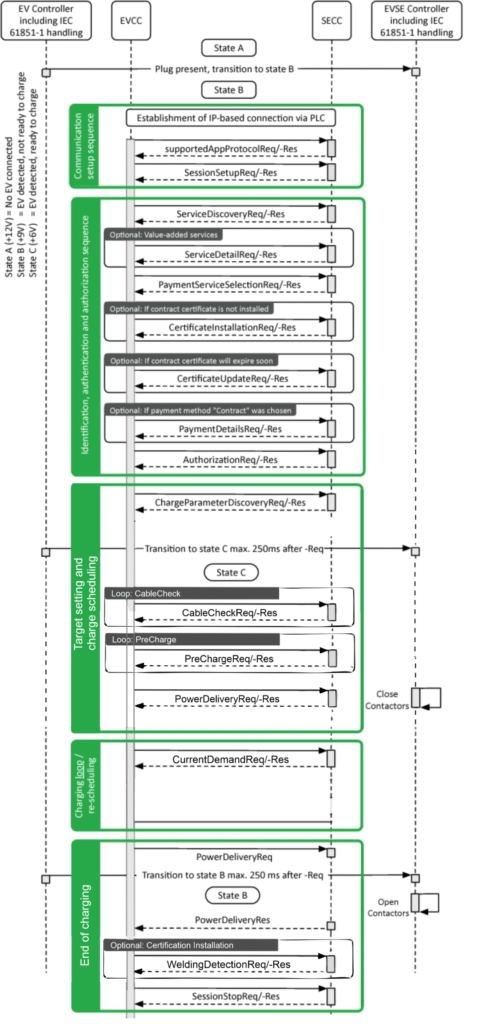
A detailed explanation of the sequence is as follows:
Communication Setup Sequence
- supportedAppProtocolRequest: Electric vehicles (EVs) and charging stations use this request-response message pair to agree on a protocol version. During this transition phase, it is crucial for the EV and the charging station to use the same version of ISO 15118-2. If they are incompatible, the ISO 15118-2 charging session cannot be initiated.
- SessionSetupRequest: Used to assign a unique session ID to the communication session. The session can be paused and resumed later using the same session ID. In such cases, the previously agreed charging parameters will be applied again to ensure charging continues in line with the driver’s original intent.
Identification, Authentication, and Authorization Sequence
- ServiceDiscovery: The electric vehicle (EV) queries the charging station for its service types. These services include single-phase AC charging, three-phase AC charging, DC charging variants, available identification mechanisms (External Identification Means (EIM) or Plug & Charge), and optional value-added services (e.g., internet access for downloading additional data). The EV can request more details about each service using the optional ServiceDetailRequest message.
- PaymentServiceSelection: Once the identification mechanism, charging mode, and optional value-added services to be used are confirmed, the EV notifies the charging station via a PaymentServiceSelection Request.
- CertificateInstallation: If the EV selects Plug & Charge as the identification method, a valid digital contract certificate must be installed to enable the charging station to automatically authenticate and authorize the driver. If the EV has not yet installed this certificate or its existing contract certificate has expired, the EV can use the CertificateInstallation message pair to install a new contract certificate from the charging station.
- CertificateUpdate: If the EV has a Plug & Charge contract certificate that is about to expire, the EV can be programmed to initiate a CertificateUpdate message pair to receive a new contract certificate.
- PaymentDetails: If the EV is programmed to select Plug & Charge as its identification method, it needs to present its contract certificate to the charging station for driver authentication and charging authorization. This is accomplished via the PaymentDetailsRequest message.
- Authorization: The authorization message pair is used to prevent replay attacks. A replay attack is a type of cyberattack in which valid data transmissions are maliciously or fraudulently repeated to gain access to restricted data.
Target Setting and Charging Scheduling
- ChargeParameterDiscovery: Electric vehicles (EVs) and charging stations communicate to exchange parameters such as maximum and minimum allowable voltage and current limits. The EV also notifies the charging station of its required energy and the expected departure time provided by the driver. The Supply Equipment Communication Controller (SECC) then calculates a charging plan and proposes it to the EV. The proposed plan will include the maximum power allowed for the EV to charge while connected to the charging station, as well as optional electricity selling prices. Electricity selling tariffs include schedules that provide time-varying costs, costs related to power demand and energy volume, or a combination of these pieces of information, and are designed to incentivize EVs to adopt specific charging behaviors.
- CableCheck: For safe DC charging, a cable inspection shall be conducted. The CableCheckReq requests the cable inspection status of the EV Supply Equipment (EVSE) – for example, informing the EVSE whether the connector is locked on the EV side and whether the EV is ready for charging. After receiving the CableCheckReq, the SECC sends a CableCheckRes containing information about the cable inspection and EVSE status.
- PreCharge: Pre-charging is used to adjust the output voltage of the EVSE to match the EV battery voltage. The EV sends a pre-charging request that includes the requested DC current (maximum inrush current) and the requested DC voltage. After receiving the PreChargeReq, the SECC sends a PreChargeRes to notify the EV of the EVSE status and the current EVSE output voltage.
- PowerDelivery: The exchange of PowerDelivery messages marks the EVSE supplying voltage to its output power socket. After the power supply equipment feeds back that it is ready for energy transmission, the EV sets a DC current request to start energy transmission. By sending a PowerDeliveryReq, the Electric Vehicle Communication Controller (EVCC) requests the SECC to supply power and transmits the charging profile that the EVCC will follow during the charging process. After receiving the PowerDeliveryReq message, the SECC sends a PowerDeliveryRes message, which includes information on whether power is available.
Charging Cycle/Rescheduling
- CurrentDemand: For DC charging control, it is necessary to cyclically exchange the requested current from the electric vehicle (EV) side. In addition, the target voltage and the difference between current and voltage are also transmitted. By sending a CurrentDemandReq, the EV requests a specific current from the EV Supply Equipment (EVSE). After receiving the CurrentDemandReq, the Supply Equipment Communication Controller (SECC) sends a CurrentDemandRes to notify the EV of the EVSE status, as well as the current output voltage and current. At this point, we enter the charging cycle.
End of Charging
- PowerDelivery: Once the electric vehicle (EV) intends to pause or end the charging session in accordance with its calculated charging plan, it will send another PowerDeliveryRequest message and set its parameter ChargePress to “Stop”. If the EV battery reaches the State of Charge (SoC) for charging completion, the charging session will stop.
- WeldingDetection: The WeldingDetection message enables the implementation of a welding detection mechanism in compliance with IEC 61851. It is used to prevent welding of the EV contactor.
- SessionStop: Communication ends with the SessionStopReq/-Res message pair. The ChargingSession parameter can be set to “Terminate” or “Pause”. If the charging session is to be paused, the charging station will temporarily store certain parameters (e.g., the agreed charging schedule) to apply these values when charging resumes.